Claude Opus 4.7 Tops the Arena. Developers Disagree.
Table of contents
Anthropic shipped Claude Opus 4.7 on April 16, 2026. Within 48 hours it claimed the #1 overall spot on Arena's text leaderboard with a score of 1505, narrowly edging Opus 4.6 at 1503. It also took #1 in Writing, Literature & Language. In Expert and Coding categories it sits comfortably in the top two.
The official benchmarks paint a clear picture of improvement. The community reception is more complicated.
What the Benchmarks Say
Opus 4.7 beats Opus 4.6 on 12 of 14 reported benchmarks at the same $5/$25 per million token pricing.
Coding
The headline numbers are strong. SWE-bench Verified jumps from 80.8% to 87.6%, a 7-point gain that puts it ahead of Gemini 3.1 Pro (80.6%) and GPT-5.4. On SWE-bench Pro, the harder multi-language variant, Opus 4.7 goes from 53.4% to 64.3%, leapfrogging GPT-5.4 at 57.7%.
Cursor reported their internal benchmark jumped from 58% to 70%. Notion saw a 14% performance lift with one-third fewer tool errors. TerminalBench 2.0 hit 69.4%, up 4 points, and Opus 4.7 passed three tasks that no prior Claude model could solve.
Vision
This is where the jump is most dramatic. Opus 4.7 accepts images up to 2,576 pixels on the long edge, roughly 3.75 megapixels. That is more than three times the resolution limit of prior Claude models.
The XBOW Visual Acuity benchmark tells the story: 98.5% on Opus 4.7 versus 54.5% on Opus 4.6. OSWorld-Verified climbs from 72.7% to 78.0%, ahead of GPT-5.4 at 75.0%. Document reasoning accuracy goes from 57.1% to 80.6%.
Reasoning
Anthropics internal evaluations show 21% fewer errors on OfficeQA Pro when working with source information. On the Research-Agent benchmark for General Finance, Opus 4.7 scored 0.813 versus Opus 4.6 at 0.767. ARC-AGI-2 hit 75.83%.
A new xhigh effort level sits between high and max, giving finer control over the tradeoff between reasoning depth and latency. Claude Code now defaults to this tier.
What the Benchmarks Miss
Not everything improved.
MRCR Collapse
Multi-Round Context Recall dropped from 78.3% on Opus 4.6 to 32.2% on Opus 4.7. That is a 46-point cliff. MRCR measures a model's ability to retrieve specific information from earlier in a long conversation. Developers working with long documents noticed immediately.
Anthropics Boris Cherny responded that MRCR is being phased out because it overweights distractor-stacking tricks and that Graphwalks is a better applied-reasoning signal. That may be true. But users feeding 800-line workflow documents into the model are reporting outputs completely unrelated to the content they provided.
The Silent Tokenizer Tax
Opus 4.7 ships with a new tokenizer. The per-token price stays at $5/$25 per million. But the same text now consumes 1.0 to 1.35 times more tokens, meaning effective costs can rise up to 35% for equivalent workloads. Anthropic argues that improved reasoning efficiency reduces overall token consumption by up to 50% on complex tasks. Whether that nets out depends entirely on your use case.
The Hallucination Question
On BenchLM, the hallucination rate dropped from 61% on Opus 4.6 to 36% on Opus 4.7. That sounds like progress, but 36% is still not production-grade for factual tasks. A separate BridgeBench test on Hacker News showed Opus 4.6 accuracy dropping from 83% to 68% over time, raising questions about model stability across the 4.x line.
What Developers Are Saying
The community is split.
CodeRabbit reports that Opus 4.7 finds more real bugs, produces more actionable feedback, and reasons across files better than anything they have tested. For agentic coding workflows, the upgrade is meaningful.
But a Reddit post titled "Claude Opus 4.7 is a serious regression, not an upgrade" hit 2,300 upvotes. An X post suggesting Opus 4.7 was not really an improvement over 4.6 got 14,000 likes. Reports include the model rewriting resumes with fabricated schools, claiming to have read documents it clearly did not process, and what one user called "being lazy" about cross-referencing.
The strawberry test made its rounds again. Opus 4.7 reportedly said there were two Ps in "strawberry."
The Arena Picture
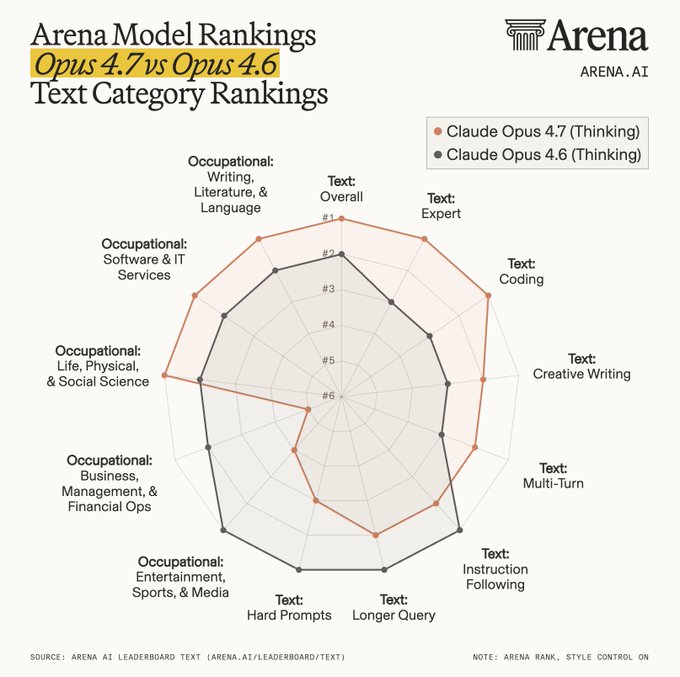
On Arena's text leaderboard with style control on, Opus 4.7 (Thinking) holds #1 overall at 1505 Elo. Opus 4.6 (Thinking) sits at #2 with 1503. The gap is 2 points, which is within the margin of error.
But the category breakdown is more revealing. Opus 4.7 dominates in Writing, Literature & Language and holds strong positions in Expert and Coding. In occupational categories like Software & IT Services and Life, Physical & Social Science, the models are nearly identical. The radar chart shows Opus 4.7 pulling ahead on the creative and expert dimensions while the occupational categories remain tightly clustered.
This aligns with the benchmark story: meaningful gains in coding and vision, marginal gains in general knowledge, and a notable regression in long-context recall.
The Mythos Shadow
Anthropics own blog post concedes that Opus 4.7 trails the unreleased Mythos model. Axios reported this directly. Gizmodo was less diplomatic, titling their coverage "Anthropic Releases Claude Opus 4.7 to Remind Everyone How Great Mythos Is."
Mythos remains restricted to roughly 40 organizations including Amazon, Apple, Microsoft, and JPMorgan Chase. Opus 4.7 is the best Anthropic will sell you. Whether that is enough depends on whether your workload hits the sweet spots (coding, vision, instruction following) or the weak spots (long context, cost sensitivity).
The Verdict
Opus 4.7 is a real upgrade for agentic coding, vision tasks, and instruction following. The SWE-bench and vision numbers are not incremental. They represent genuine capability jumps that change what you can delegate to the model.
But it is not a universal upgrade. The MRCR collapse is real and affects long-document workflows. The tokenizer change is a hidden cost increase. And the community backlash suggests that vibes-based evaluation, which is what most developers actually do, tells a different story than benchmarks.
The Arena ranking confirms what the numbers suggest: Opus 4.7 is the best generally available model by a narrow margin. The question is whether that margin matters for your specific use case, or whether the regressions matter more.
Same price. Better at code. Better at vision. Worse at long context. More expensive in practice. That is the real scorecard.