Out-vibe: The Verb I Needed for Shipping Faster Than People Can Dream
Table of contents
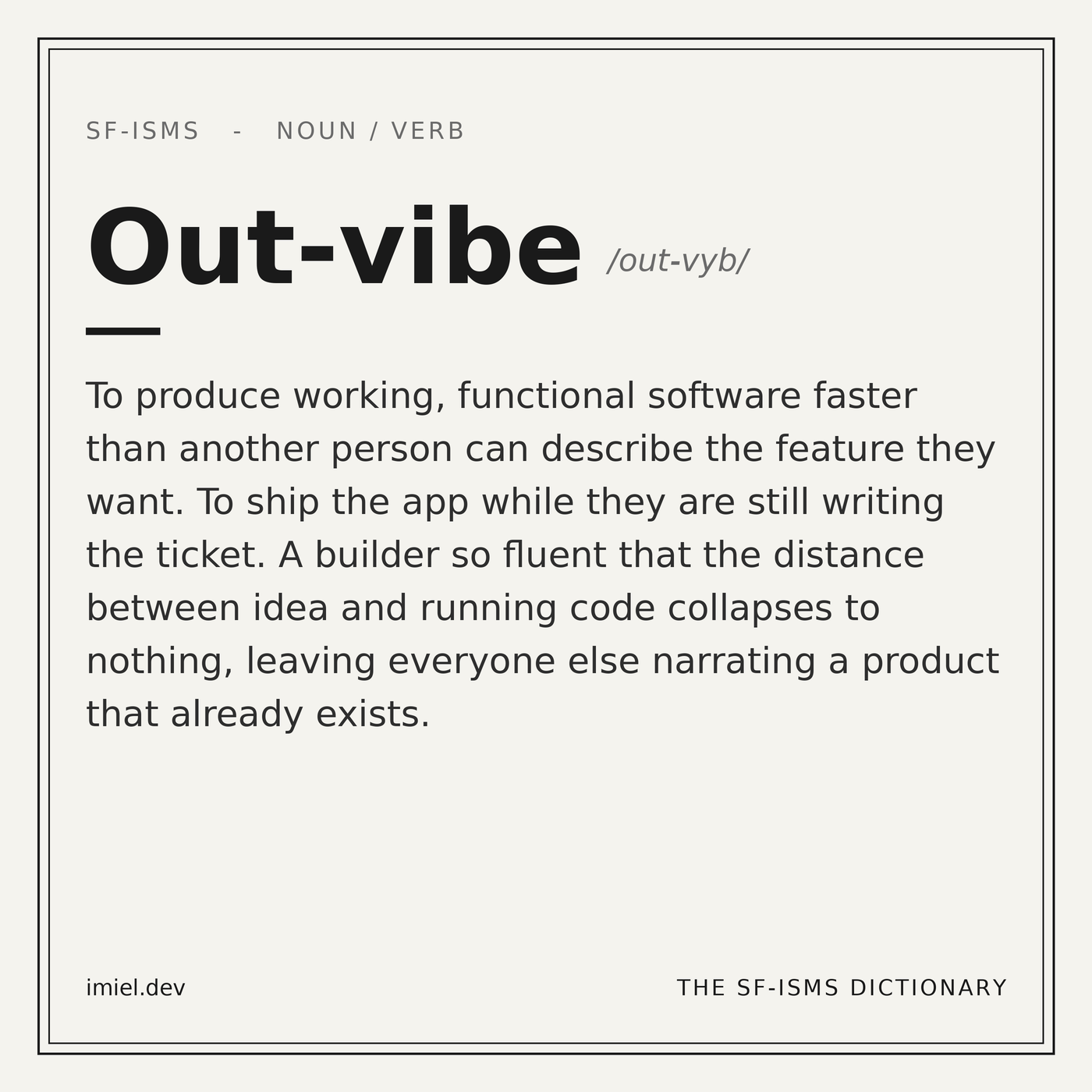
I needed a new verb.
Not a noun, not a job title, not another framework for the maturity curve. A verb. Something I could say in a sentence that captures what actually happens now when two people sit in the same meeting and one of them has already built the thing the other is still explaining.
So I am coining it. Out-vibe.
The definition
To out-vibe someone is to produce working, functional software faster than they can describe the feature they want. To ship the app while they are still writing the ticket. It is not about typing speed and it is not about being smarter. It is about the distance between an idea and running code collapsing to nothing for one person while it stays a canyon for everyone else.
You use it like any other verb.
"I out-vibed the whole sprint before standup."
"We got out-vibed by a solo founder with a laptop and a weekend."
"Stop speccing it. He is going to out-vibe you while you finish the Notion doc."
The gerund works too. Out-vibing is the ongoing state of being so fluent at building that the meeting cannot keep up with you. The past tense is the one that stings. Nobody wants to be the person who got out-vibed.
Why the word needs to exist
For most of software history, the bottleneck was production. Someone had the idea, and then a team spent weeks turning it into something real. The idea was cheap and the building was expensive, so we organized everything around the building: tickets, estimates, sprints, handoffs, the whole ceremony of turning a sentence into a shipped feature.
Vibe coding quietly inverted that. The building got cheap. For the people who are fluent with it, a feature is no longer a two-week project, it is a twenty-minute conversation with a machine that writes the code. And when building gets that cheap, the bottleneck moves. It moves to deciding. It moves to knowing what is worth building at all.
That is the gap out-vibe names. The person who gets out-vibed is rarely a worse engineer. They are a slower decider. They are still forming the thought while the other person has already shipped three versions of it and is reading the first user's reaction. The canyon is not talent. It is the willingness to let the machine close the distance between intent and reality while you are still talking.
The two species
Every meeting now has both.
The out-viber treats the conversation as the slow part. They are not waiting for permission to build, because building is no longer the thing that costs. They prototype in the margins of the discussion. By the time the room agrees on what to do, they are demoing why the obvious version is wrong and showing the one that works instead.
The out-vibed treats the build as the slow part, because for them it still is. They are optimizing the spec, because in their world a good spec saves two weeks of expensive engineering. They do not yet feel that the two weeks became twenty minutes. So they bring a perfect description of a product to a person who already has the product open in another tab.
Neither is lazy. The out-vibed person is working exactly as hard. They are just defending the wrong bottleneck.
How not to get out-vibed
The uncomfortable part is that you cannot out-type your way out of this. Getting marginally faster at writing code is defending the bottleneck that already moved. The leverage is not in production anymore.
The way you stop getting out-vibed is the same way you start out-vibing: you let the building get cheap for you too, and you move your effort to the part that is now scarce. Stop protecting the spec. Start protecting the taste. The person who out-vibes is not winning on code, they are winning on the speed of the loop from idea to running thing to feedback to next idea. That loop is buildable. I have written about building it as loop engineering, where the point is to stop being the bottleneck in your own workflow.
Out-vibe is just what it looks like from across the table. One person built the machine that closes the distance. The other is still narrating a product that, as far as the first person is concerned, already exists.
Stop writing the ticket. Out-vibe it.